
Data export · B2B SaaS · Design Challenge · UX Design
Nov 2025 - Dec 2025
Company
Minderest
Role
Product Designer
Tools
Figma , Figma Make
Fixing a broken export flow — from 30% to 90% completion
Designing a B2B and B2C event platform through a full product MVP
Context
Minderest is a B2B SaaS platform used by retailers and e-commerce brands to monitor competitors and optimise pricing strategies. Data export is not a peripheral feature — it's a core daily workflow. Category managers and pricing analysts rely on accurate exports to update prices, manage assortment, and feed automated pricing engines.
The problem: only 30% of started exports were completing successfully. For a tool where data freshness directly affects pricing decisions, that gap had real commercial consequences.
This was a one-week design challenge. No access to live data — I worked with a structured research simulation and clearly stated assumptions throughout.
The Work
The Users
Two personas with different failure modes.
Category Managers — need quick exports for pricing adjustments. Value speed over flexibility. Abandon when configuration takes too long.
Pricing Analysts — run similar exports several times a week. Need customisation without starting from scratch each time. Abandon when there's no way to save or reuse configurations.
What the research found
Working from analytics simulation and support ticket patterns, four failure points emerged in priority order:
40–50% drop-off at field selection — a long, unstructured list with no guidance. Heavy reuse of similar exports by power users with no way to save configurations. Generic error messages with no recovery path. Performance issues on large catalogs during peak hours.
Three approaches
The Users
Approach A
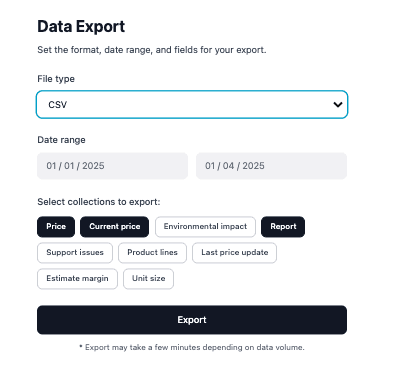
One-shot manual export
Full control, low implementation effort.
Perpetuates the exact configuration overload causing drop-off.
Rejected.
Approach B
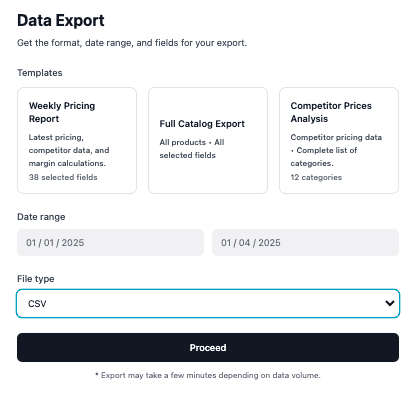
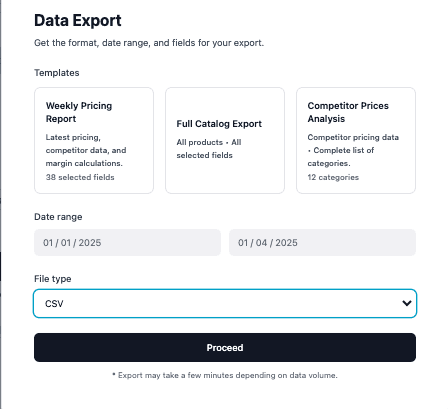
Template-first export
Fast for common use cases, works well for Category Managers.
Completely blocks Pricing Analysts with edge-case needs.
Rejected.
Approach C
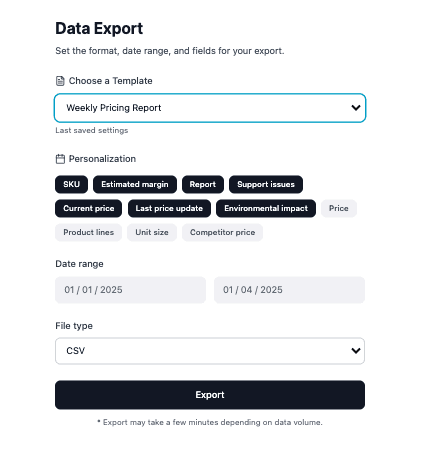
Templates + customisable fields
Hybrid model
Quick-start templates + last used settings + expandable field customisation
✅ The only approach that serves both personas without compromise.
The solution
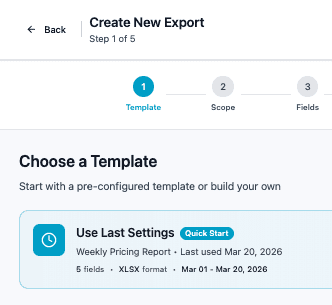
Templates + last used settings
Repeat frequent exports in a few clicks instead of rebuilding from scratch.
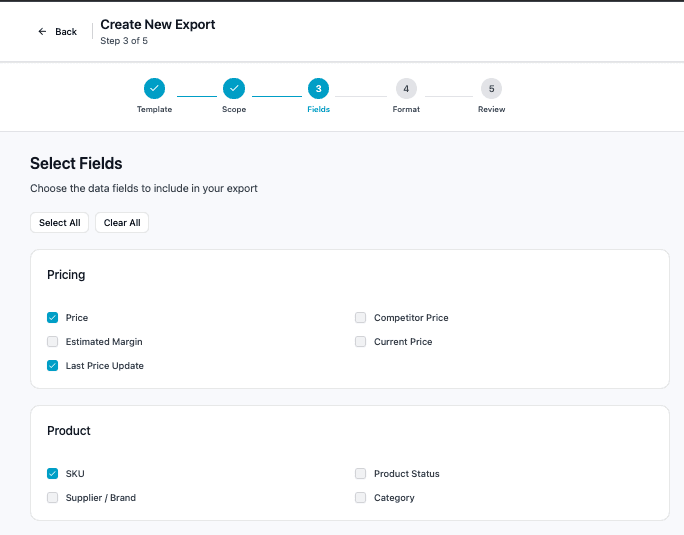
Progressive disclosure
Collapsible sections keep the default view simple. Power users get advanced controls without a separate flow.
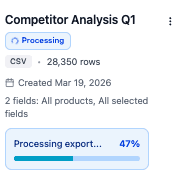
Inline progress feedback
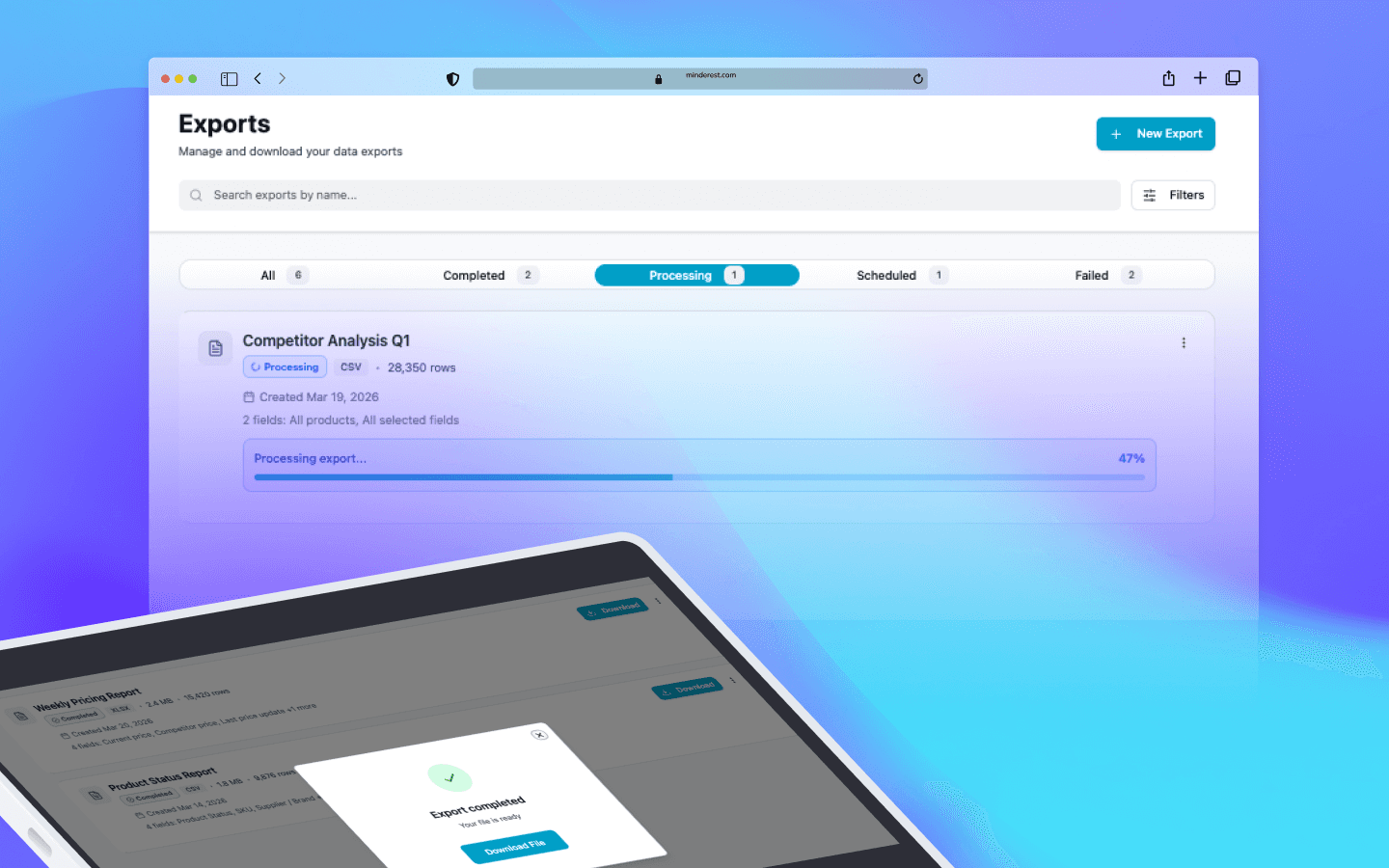
Export status and a clear "Your file is ready" completion state directly address the abandonment anxiety causing mid-wait drop-off.
What this taught me
Designing without real data forces you to make your assumptions explicit — which turns out to be useful discipline even when you do have data. Every decision in this project has a documented reason. That's a habit I want to keep.
The bigger lesson: in B2B tools, edge cases aren't edge cases. They're the product.
Data export · B2B SaaS · Design Challenge · UX Design
Nov 2025 - Dec 2025
Minderest
Figma , Figma Make
Product Designer
Fixing a broken export flow — from 30% to 90% completion
Designing a B2B and B2C event platform through a full product MVP
Context
Minderest is a B2B SaaS platform used by retailers and e-commerce brands to monitor competitors and optimise pricing strategies. Data export is not a peripheral feature — it's a core daily workflow. Category managers and pricing analysts rely on accurate exports to update prices, manage assortment, and feed automated pricing engines.
The problem: only 30% of started exports were completing successfully. For a tool where data freshness directly affects pricing decisions, that gap had real commercial consequences.
This was a one-week design challenge. No access to live data — I worked with a structured research simulation and clearly stated assumptions throughout.
The Users
Two personas with different failure modes.
Category Managers — need quick exports for pricing adjustments. Value speed over flexibility. Abandon when configuration takes too long.
Pricing Analysts — run similar exports several times a week. Need customisation without starting from scratch each time. Abandon when there's no way to save or reuse configurations.
What the research found
Working from analytics simulation and support ticket patterns, four failure points emerged in priority order:
40–50% drop-off at field selection — a long, unstructured list with no guidance. Heavy reuse of similar exports by power users with no way to save configurations. Generic error messages with no recovery path. Performance issues on large catalogs during peak hours.
The Work
Tree approaches
Approach A
One-shot manual export
Full control, low implementation effort.
Perpetuates the exact configuration overload causing drop-off.
Rejected.
Approach B
Template-first export
Fast for common use cases, works well for Category Managers.
Completely blocks Pricing Analysts with edge-case needs.
Rejected.
Approach C
Templates + customisable fields
Hybrid model
Quick-start templates + last used settings + expandable field customisation
✅ The only approach that serves both personas without compromise.
The solution
Progressive disclosure
Collapsible sections keep the default view simple. Power users get advanced controls without a separate flow.
Templates + last used settings
Repeat frequent exports in a few clicks instead of rebuilding from scratch.
Inline progress feedback
Export status and a clear "Your file is ready" completion state directly address the abandonment anxiety causing mid-wait drop-off.
What this taught me
Designing without real data forces you to make your assumptions explicit — which turns out to be useful discipline even when you do have data. Every decision in this project has a documented reason. That's a habit I want to keep.
The bigger lesson: in B2B tools, edge cases aren't edge cases. They're the product.